- Home
-
Company Profile
- About Us
- About Our Export
- What We Do
- Precision Machining Capabilities & Manufacturing Process
- Products We Manufacture: Precision Components & Work Holding Solutions
- Custom Manufacturing & OEM Engineering Solutions
- Industries We Serve
- Quality Assurance, Certifications & Standards
- Infrastructure, Technology & Manufacturing Facilities
- Our Products
- Blogs
- Contact Us

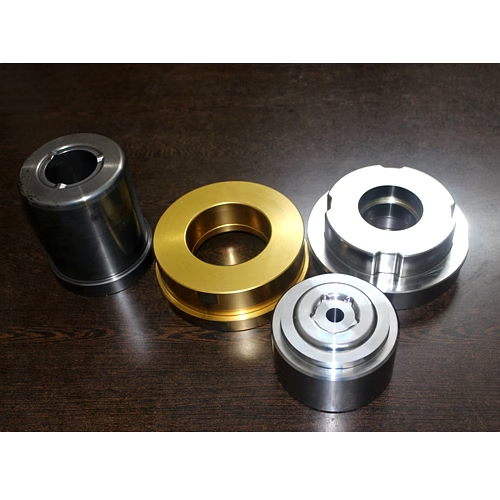

Cold Forging Die
-
Product is not available
Brand:
Country Of Origin : India
Cold Forging Die for Production Runs
Cold forging dies are engineered cavities or tooling sets that shape workpieces under compressive load at room temperature. They form the matched interface to punches and must be specified with precise cavity geometry and finish to control final part dimensions.
Buyers evaluate die cavity tolerance, surface finish, and compatibility with press stroke and feeder systems. Maintenance and repeatability are central for production planning. When ordering, provide detailed part drawings and anticipated production volumes to align tooling design and inspection checkpoints.
Supply options include batch machining with inspection reporting. Dies can be delivered with recommended clearances and assembly guidance for integration into existing die stacks.
Engineering Summary
A cold forging die contains the negative geometry required to form or blank a metal blank. Critical attributes include cavity profile, entry/exit radii, and die surface finish. Die material and heat treatment are chosen to resist abrasive wear and maintain dimensional stability across production runs.
Manufacturing Notes
Die manufacturing methods emphasize accurate cavity machining and finishing. EDM, grinding, and polishing are common secondary operations to achieve specified surface quality. Die sets are often supplied with shims or alignment features to assure repeatable seating in press platens. Where applicable, wear inserts can be used for extended run life and simplified maintenance.
Use Cases
1. High-volume OEM forming where consistent part geometry is required across long production runs.
2. Toolroom and maintenance replacement where interchangeability with existing die sets reduces downtime.
3. Prototyping-to-production handoffs where tooling revisions are anticipated based on first-run results.
Supply & Inspection
Production batches can include dimensional inspection reports and suggested run clearances. Provide part documentation and anticipated lot size to receive a tailored production plan and lead-time estimate.
Frequently Asked Questions
- What cavity tolerances are supported? Cavity tolerances depend on drawing requirements and machining route; submit part drawings to confirm achievable tolerances.
- Can dies be produced to custom CAD drawings? Yes. Provide CAD/2D drawings and specification notes for build-to-print quoting and validation planning.
- What inspection documentation is offered? Dimensional inspection reports and batch traceability can be provided per delivery.
- How are dies packed for dispatch? Protective packaging is selected to preserve precision surfaces and alignment features during transport.