- Home
-
Company Profile
- About Us
- About Our Export
- What We Do
- Precision Machining Capabilities & Manufacturing Process
- Products We Manufacture: Precision Components & Work Holding Solutions
- Custom Manufacturing & OEM Engineering Solutions
- Industries We Serve
- Quality Assurance, Certifications & Standards
- Infrastructure, Technology & Manufacturing Facilities
- Our Products
- Blogs
- Contact Us

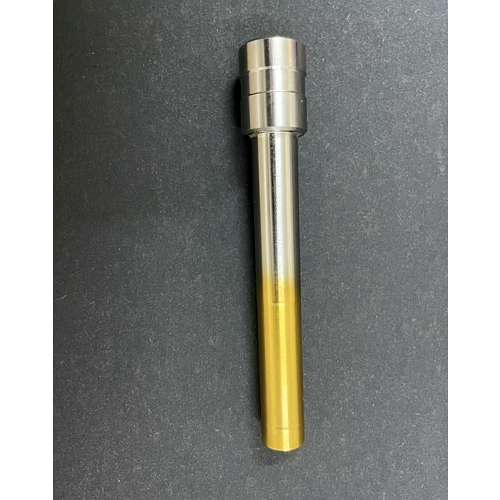

Cold Forging Punch
-
Product is not available
Brand:
Country Of Origin : India
Cold Forging Punch for Industrial Forming
Cold forging punches are precision metal-forming tools designed to shape and blank workpieces under compressive loads at ambient temperatures. This punch variant is suited to OEM and production environments where repeatability and tool life are primary buyer concerns.
Key buyer signals include consistent dimensional repeatability and process stability for high-volume runs. Procurement teams typically evaluate punch geometry, wear resistance, and compatibility with existing dies and presses. Where required, production batches can be scaled and inspection checkpoints integrated to support ongoing supply programs.
For purchasing and specification, provide drawing references, target material, and expected run volumes. This facilitates quoting and helps match production process capability to the part requirement.
Technical Overview
A cold forging punch is a hardened tool designed to transfer compressive force to a blank for forming or piercing operations. Typical considerations include punch profile tolerance, edge radius, and surface finish to control burr formation and ensure consistent die clearance. Material selection for the punch itself is driven by wear resistance and toughness for extended run lengths.
Design and Manufacturing Considerations
Designers should reference punch diameter and head geometry when specifying mating die features. Heat treatment and surface hardening extend punch life under repeated impact and shear. Dimensional control on the punch nose and shank ensure repeatable alignment in die assemblies. Where applicable, runners and support features are matched to press ram motion to avoid misalignment and premature wear.
Applications
1. OEM production lines requiring high repeatability for stamped or formed metal components. Procurement teams use these punches for long-run manufacturing.
2. Maintenance and replacement programs where in-field downtime is minimized by stocked spares with known tolerances and fit.
3. Prototype-to-production handoffs where a controlled tool route is needed for ramped volumes.
Procurement & Supply Terms
We offer batch production planning, with the ability to scale runs as required. Provide 2D/3D drawings and target volumes to receive lead-time and costing estimates. Inspection checkpoints and dimensional reports can be supplied as part of the delivery package.
Frequently Asked Questions
- What tolerances can be maintained for this punch? Typical tolerances are driven by drawing requirements and press capability; provide target dimensions to validate achievable tolerance bands.
- How does production scale affect lead time? Lead time is scheduled by batch size and machining route; higher volumes require production planning and lead scheduling.
- What compliance or inspection documentation is available? Dimensional inspection reports and batch traceability can be provided on request to support procurement validation.
- What packaging and dispatch options are used? Transit-safe industrial packing is selected based on part geometry to protect critical surfaces during shipment.