- Home
-
Company Profile
- About Us
- About Our Export
- What We Do
- Precision Machining Capabilities & Manufacturing Process
- Products We Manufacture: Precision Components & Work Holding Solutions
- Custom Manufacturing & OEM Engineering Solutions
- Industries We Serve
- Quality Assurance, Certifications & Standards
- Infrastructure, Technology & Manufacturing Facilities
- Our Products
- Blogs
- Contact Us

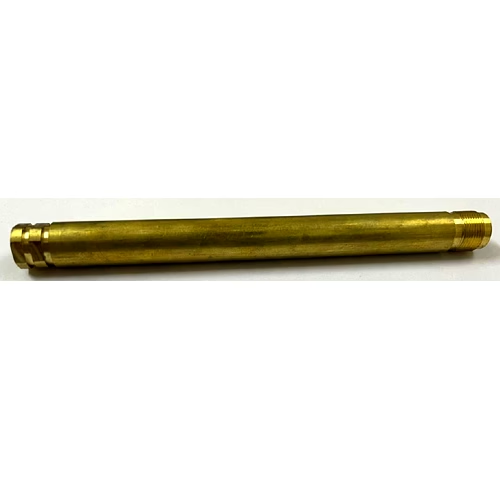

Shaft Body For Hand Blender
-
Product is not available
Brand:
Country Of Origin : India
Shaft Body for Hand Blender Assemblies
The shaft body is a key mechanical component in hand blender assemblies that transmits motor torque to the blade. It must meet dimensional and concentricity requirements to avoid vibration and ensure assembly balance.
Procurement teams should provide shaft dimensions, bore fits, and material preferences to ensure compatibility with motor coupling and blade assemblies. Volume forecasts allow manufacturing to plan production batches and inspection checkpoints.
Share drawings and expected volumes for accurate lead-time and costing estimates. Supply can include dimensional inspection reports as part of delivery.
Technical Overview
Shaft bodies serve as rotating links between motor output and blade assemblies. Critical attributes include straightness, concentricity, bore tolerance for coupling elements, and surface condition where seals or bearings interface. Material selection balances strength with corrosion resistance for food-contact or damp environments.
Manufacturing Considerations
CNC turning and finishing operations achieve required diameters and tolerances. Where applicable, surface treatments and passivation can be applied to improve corrosion resistance. Dimensional inspection of runout and concentricity supports assembly acceptance criteria and helps prevent vibration-induced failures.
Applications
1. OEM hand blender production where shaft alignment and balance are essential.
2. Replacement-part programs ensuring fit and rotational stability in maintenance scenarios.
3. Prototype validation requiring close tolerance runs for performance testing.
Procurement Notes
Provide detailed drawings and coupling interface specs to receive lead-time and pricing. Batch inspections and traceability records can be provided to support incoming quality checks.
Frequently Asked Questions
- What concentricity tolerances are feasible? Concentricity is dependent on machining route and part geometry; provide drawings to confirm target tolerances.
- Can shaft bodies be produced from different materials? Yes. Specify material preference and operating environment for material selection and finishing options.
- What inspection documentation is available? Dimensional inspection reports and runout checks can be supplied per batch.
- How are parts packed? Protective packing is used to prevent surface damage during shipment.