- Home
-
Company Profile
- About Us
- About Our Export
- What We Do
- Precision Machining Capabilities & Manufacturing Process
- Products We Manufacture: Precision Components & Work Holding Solutions
- Custom Manufacturing & OEM Engineering Solutions
- Industries We Serve
- Quality Assurance, Certifications & Standards
- Infrastructure, Technology & Manufacturing Facilities
- Our Products
- Blogs
- Contact Us

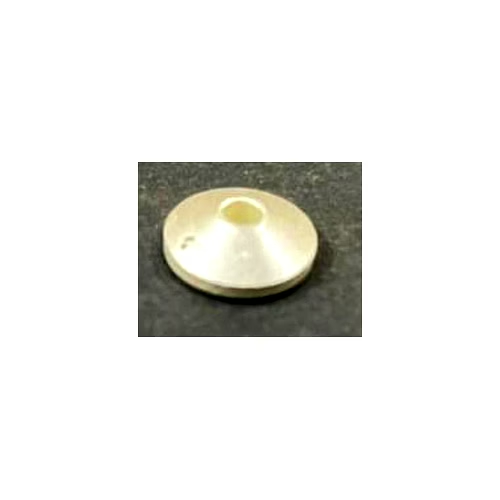

Silver Plated Contact For Relays
-
Product is not available
Brand:
Country Of Origin : India
Silver Plated Contact for Relay Switching
Silver plated contacts are used in relay and switching applications where low contact resistance and reliable conductivity are required. The silver plating improves electrical performance and reduces contact wear in low-current switching cycles.
Procurement teams should specify contact geometry, substrate material, and anticipated current/voltage to align plating thickness and contact finishing. Batch supply can include inspection reporting covering plating thickness and dimensional conformity.
Provide drawings and electrical requirements to obtain production planning and lead-time information.
Technical Summary
Silver plated contacts combine a conductive substrate with a silver coating to ensure low contact resistance and improved contact life. Key parameters include plating thickness, contact area geometry, and substrate material to support mechanical strength and conductivity. Plating process control is important to ensure adhesion and consistent thickness across production lots.
Design & Performance
Designers should confirm mating contact geometry and switching envelope. For arcing-prone applications, contact area design and plating thickness are balanced to optimize life and reduce material transfer. Dimensional control is necessary for repeatable operation in relay assemblies.
Applications
1. Relay contacts in control panels and switching systems requiring reliable low-resistance connections.
2. Replacement contacts for maintenance programs where consistent electrical performance matters.
3. OEM assembly production with specified electrical and dimensional tolerances.
Supply & Quality
Batch production options include plating-thickness measurement and dimensional inspection reports. Share electrical and mechanical specifications to receive accurate lead-time and pricing.
Frequently Asked Questions
- What plating thickness is provided? Specify electrical and mechanical requirements so plating thickness and process can be validated for life and performance.
- Are parts produced to custom drawings? Yes. Submit CAD or 2D drawings and electrical spec to enable build-to-print quoting.
- What inspection reports are supplied? Plating-thickness checks and dimensional inspection reports can be provided per batch.
- How are contacts packaged? Contacts are packed to protect plated surfaces and contact faces during transit.