- Home
-
Company Profile
- About Us
- About Our Export
- What We Do
- Precision Machining Capabilities & Manufacturing Process
- Products We Manufacture: Precision Components & Work Holding Solutions
- Custom Manufacturing & OEM Engineering Solutions
- Industries We Serve
- Quality Assurance, Certifications & Standards
- Infrastructure, Technology & Manufacturing Facilities
- Our Products
- Blogs
- Contact Us

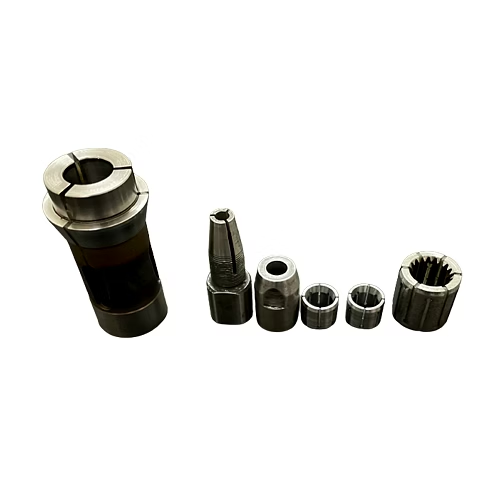

Special purpose Collet
-
Product is not available
Brand:
Country Of Origin : India
special purpose collet for tooling
Special purpose collets are configured for non-standard tool profiles or delicate workpiece geometries. These collets focus on tailored gripping faces, reduced contact pressure, or modified taper geometries to protect thin-walled parts during machining. The design is selected where off-the-shelf collets do not satisfy fit or handling constraints.
Procurement teams deploy special purpose collets for fixtures, low-distortion machining, and sub-assembly operations where part integrity is essential. Specification steps include confirming tool-holder interfaces and supplying sample parts or CAD geometry for evaluation. Inspection checkpoints are recommended before production release.
Commercial options include wholesale order bands for production runs and batch inspection traceability. Packaging and handling are arranged to preserve contact surfaces. This collet type is suited to OEM buyers, maintenance planners, and project procurement teams that require bespoke gripping behavior.
Applications and buyer workflows
Special purpose collets are applied where standard clamping would deform or mar critical surfaces. Use-cases include thin-walled component machining, delicate finishing cycles, and assembly operations that require consistent part orientation without excess clamping force. Buyers should define the operational constraint and provide sample geometry for qualification.
Design and manufacturing considerations
Manufacturing adapts tooling and internal profiles to meet bespoke gripping needs. Processes emphasize controlled grinding and finishing steps to maintain contact geometry and surface integrity. When necessary, protective coatings or surface treatments are selected to reduce friction and wear while preserving part surface quality.
Quality and inspection
Qualification typically includes sample validation, dimensional inspection, and batch traceability. Inspection reports demonstrate the interface fit and gripping behavior across production lots. Buyers should request sample trials prior to full-scale runs to confirm handling and performance under real operating conditions.
Commercial and supply terms
Wholesale order arrangements support volume production with scaled inspection checkpoints. Lead time and production scheduling are adjusted for tooling changes and sample approvals. Protective packing and part-specific dispatch methods are used to keep gripping faces intact during transit.
Frequently Asked Questions
- What tolerance band and interface standard does this collet support? Tolerance and interface details are set per drawing; provide the tool-holder interface for precise matching.
- Can this collet be produced to custom CAD drawings? Yes. Drawing-based production with dimensional validation is supported for qualifying production runs.
- What test reports or compliance evidence are available for this SKU? Dimensional inspection records and batch traceability are provided where required.
- What is lead time and packaging for special runs? Lead time depends on tooling changes and approval cycles. Packing is selected to protect contact surfaces.