- Home
-
Company Profile
- About Us
- About Our Export
- What We Do
- Precision Machining Capabilities & Manufacturing Process
- Products We Manufacture: Precision Components & Work Holding Solutions
- Custom Manufacturing & OEM Engineering Solutions
- Industries We Serve
- Quality Assurance, Certifications & Standards
- Infrastructure, Technology & Manufacturing Facilities
- Our Products
- Blogs
- Contact Us

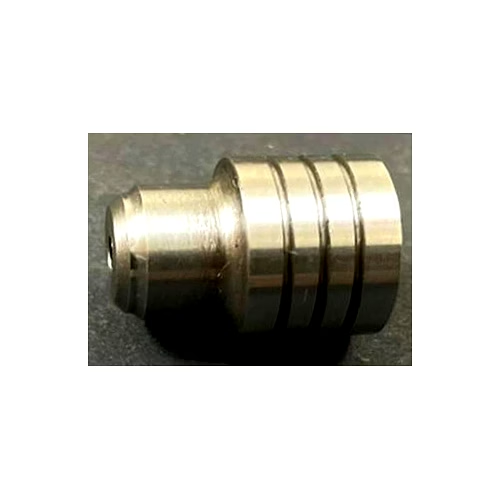

Valve For Hydraulic Control Valve
-
Product is not available
Brand:
Country Of Origin : India
Hydraulic Control Valve Component for Fluid Power
This valve component is intended for use within hydraulic control valve assemblies. It is specified where flow control, pressure regulation, or directional routing is required within a hydraulic circuit.
Procurement teams should identify system interface dimensions and operating pressure range when requesting quotes. Supplying these details enables verification of compatibility and helps define inspection checkpoints during production runs.
Supply options include batch production with inspection documentation suitable for OEM integration and assembly validation.
Technical Summary
Hydraulic control valve components are designed for precise control of fluid flow and pressure within a system. Key considerations include port geometry, sealing interface, and material compatibility with hydraulic fluids. Dimensional accuracy at sealing and mounting surfaces is critical for leak-free operation and serviceability.
Material and Sealing Considerations
Materials for valve components are selected for corrosion resistance and mechanical stability. Sealing interfaces may require tight bore tolerances and compatible surface finishes to preserve secondary seals. When specifying, indicate intended fluid type and expected operating temperature to select suitable material and seal systems.
Applications
1. OEM hydraulic manifolds and valve assemblies for industrial machinery.
2. Replacement components in maintenance programs where sealed fit and dimensional conformity are mandatory.
3. Prototype valve packs where fitment and seal verification are part of integration testing.
Supply & Procurement
Provide interface drawings and pressure expectations to receive a production plan and lead-time estimate. Bulk procurement options are available and can include dimensional inspection reports for acceptance testing by the receiving team.
Frequently Asked Questions
- What interface dimensions are required? Provide port size, thread or flange spec, and mounting hole pattern to validate compatibility with your valve body.
- Can parts be supplied for OEM integration? Yes. Share assembly drawings to align tooling and inspection requirements.
- What test or inspection reports are available? Dimensional inspection reports and material traceability can be provided with shipments.
- How are parts packaged? Transit-safe packing is selected to protect sealing surfaces and precision bores during transport.