- Home
-
Company Profile
- About Us
- About Our Export
- What We Do
- Precision Machining Capabilities & Manufacturing Process
- Products We Manufacture: Precision Components & Work Holding Solutions
- Custom Manufacturing & OEM Engineering Solutions
- Industries We Serve
- Quality Assurance, Certifications & Standards
- Infrastructure, Technology & Manufacturing Facilities
- Our Products
- Blogs
- Contact Us

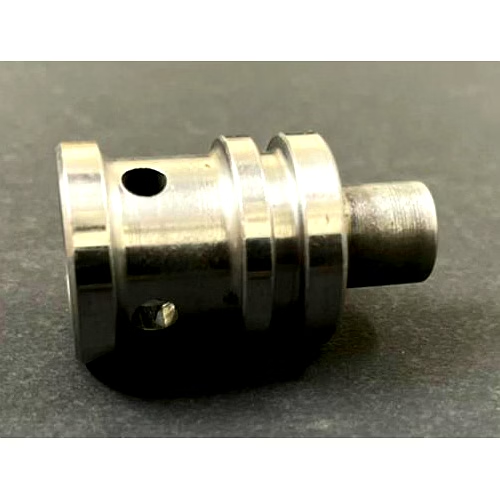

Valve For Hydraulic Control Valve Assly
-
Product is not available
Brand:
Country Of Origin : India
Component for Hydraulic Control Valve Assembly
This component is intended for assembly into hydraulic control valves. It supports flow routing, pressure control, or directional functions when integrated into a valve stack or manifold assembly.
Buyers should provide assembly drawings and operating parameters so manufacturing can verify fit and sealing performance. Batch production can be arranged with inspection checkpoints to support assembly acceptance testing.
Supplying part-level documentation and intended system interfaces accelerates quoting and production planning.
Overview
Valve assembly components must meet dimensional and sealing requirements to function as part of a hydraulic control system. Critical features include bore concentricity, port alignment, and finish quality at sealing surfaces. Manufacturing routes emphasize tight dimensional control to prevent leakage and ensure serviceability.
Manufacturing & Material
Materials are selected for fluid compatibility and mechanical performance. Heat-treated or surface-finished components can reduce wear and help maintain sealing integrity. When ordering, specify fluid type and expected operating temperature to guide material and seal selection.
Use Cases
1. OEM valve assembly production for industrial hydraulic equipment.
2. Spare components for maintenance programs requiring quick replacement.
3. Prototype assembly validation where dimensional conformity is assessed through inspection.
Procurement Notes
Submit assembly drawings and expected volumes for lead-time and pricing. Inspection reporting can be packaged with deliveries to support incoming quality checks.
Frequently Asked Questions
- What sealing interfaces are supported? Specify sealing geometry and seal type so compatibility can be verified and appropriate tolerances applied.
- Can parts be produced to assembly drawings? Yes. Provide CAD/2D drawings and required tolerances for build-to-print quoting.
- What documentation is provided on delivery? Dimensional inspection reports and traceability records are available per batch.
- How are parts shipped? Parts are packed to protect precision bores and sealing surfaces during transit.